Health Standards Concerning Wireless Power Transfer
Overview of the main international exposure guidelines and standards used to assess the safety of wireless power transfer (WPT) systems.
At a glance
- ICNIRP: International exposure guidelines for electric and magnetic fields up to 300 GHz
- IEEE C95: Exposure limits and measurement methodologies for electromagnetic field safety
- Dosimetric Reference Levels (DRL): Tissue-based exposure limits
- Exposure Reference Levels (ERL): External field limits used for compliance testing
ICNIRP Guidelines
The International Commission on Non-Ionizing Radiation Protection (ICNIRP) publishes guidelines that limit human exposure to time-varying electric and magnetic fields. These guidelines are based on scientific research and address biological effects of non-ionizing radiation over the frequency range from static fields up to 300 GHz.
Scope
- Exposure to electric, magnetic, and electromagnetic fields
- Frequency range up to 300 GHz
- Protection of the general public and workers
- Evidence-based limits derived from biological effects
Frequency-Dependent Effects
- Below 100 kHz: limits primarily address effects on the nervous system
- 100 kHz to 300 GHz: limits focus on tissue heating and other radio-frequency effects
- Both direct and indirect effects of electromagnetic fields are considered
Future Research
Recent ICNIRP reports identify knowledge gaps in the available scientific literature that may influence future updates to radio frequency exposure guidelines.
Reference Levels
IEEE C95 Standards
IEEE provides recommendations and safety limits for exposure to non-ionizing radiation through the IEEE C95 series of standards. These standards define exposure limits, assessment procedures, and measurement methodologies for electric, magnetic, and electromagnetic fields.
Key Characteristics
- Frequency range: 0 Hz to 300 GHz
- Applies to: General public and occupational environments
- Main framework: Dosimetric Reference Levels (DRL) and Exposure Reference Levels (ERL)
- Includes: Electric fields, magnetic fields, and electromagnetic radiation
Dosimetric Reference Levels (DRL)
DRLs define limits within the human body and depend on frequency. Different biological quantities are used in different frequency ranges.
- 0 Hz – 5 MHz: In-situ electric field strength
- 100 kHz – 6 GHz: Specific Absorption Rate (SAR)
- 6 GHz – 300 GHz: Epithelial power density
Although DRLs provide the fundamental protection criteria, they are difficult to measure directly during product development.
Exposure Reference Levels (ERL)
ERLs are practical limits expressed in terms of external electric field strength, magnetic field strength, and incident power density. Compliance with ERLs generally guarantees compliance with the corresponding DRLs.
- Measured outside the body
- Used in most practical compliance testing
- Allow simplified safety verification
- May be exceeded if compliance with DRL limits can be demonstrated
Measurement Standards
- IEEE Std C95.3
- IEEE Std C95.3.1
- IEC 62232
Safety Assessment of Wireless Power Transfer Systems
Wireless power transfer systems are typically evaluated against ICNIRP or IEEE exposure limits to ensure safe operation for users. The applicable assessment method depends strongly on the application and transmitted power level.
Biomedical Applications
- Usually assessed using SAR-based limits
- Direct interaction with the human body
- Lower coupling distances generally reduce exposure
- Compliance with SAR thresholds is a key design requirement
Industrial and Logistic Applications
- Require significantly higher power levels
- Generate stronger electric and magnetic fields
- Exposure Reference Levels (ERL) are commonly applied
- Safety distances may be required under worst-case operating conditions
Engineering Considerations
- Field strengths increase with transferred power
- Misalignment can affect exposure levels
- Shielding can reduce unwanted leakage fields
- Compliance verification should be included early in system design
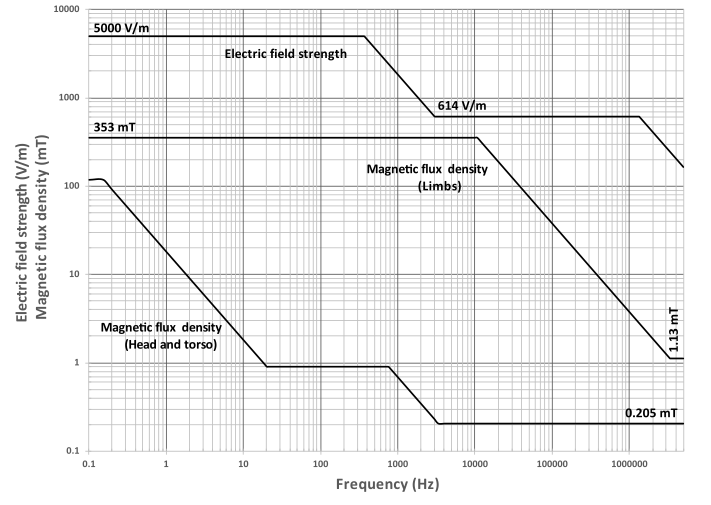
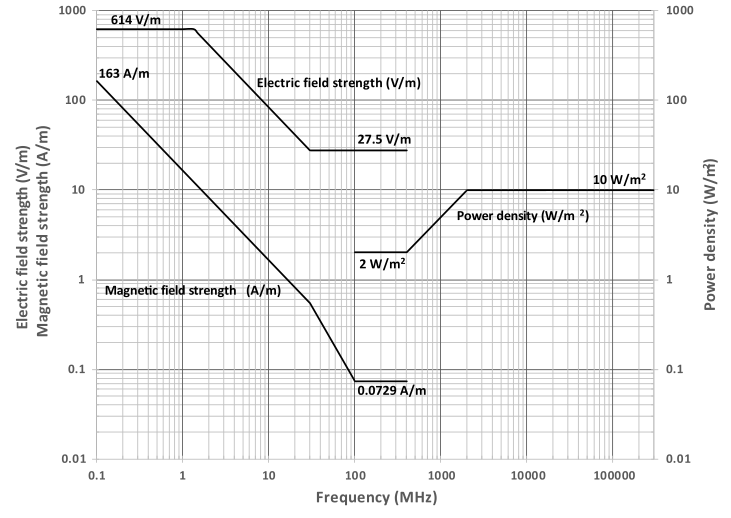
Exposure Reference Levels (ERL)
The figures below illustrate exposure reference levels for unrestricted environments as defined by the IEEE C95 standard.
Comparison of Health Standards
The table below compares the principal organizations and standards used for assessing electromagnetic field exposure in wireless power transfer systems.
| Organization | Main Standard | Frequency Range | Primary Focus |
|---|---|---|---|
| ICNIRP | Exposure Guidelines | Up to 300 GHz | Public exposure limits |
| IEEE | C95.1 | 0 Hz - 300 GHz | Exposure limits and test procedures |
| IEEE | C95.3 Series | Application dependent | Measurement methodologies |
| IEC | IEC 62232 | Application dependent | Field measurement and assessment |
Sources
Document based on:
- A. Cloet, H. Farbakhsh, M. Kleemann, and B. Minnaert, “Recent Advancements in Technologies, Applications, and Regulations of Near-Field Wireless Power Transfer,” in IEEE Access, vol. 14, pp. 49285–49310, 2026, doi: 10.1109/ACCESS.2026.3674000.