Application-Level Wireless Power Transfer Standards
Overview of the main standards and organizations shaping wireless power transfer systems.
At a glance
- NFC Forum (WLC): ultra-low power charging for IoT and wearables (0-1 W)
- WPC (Qi/Qi2): consumer electronics charging up to 30 W
- AirFuel Resonant: resonant wireless charging with greater spatial freedom (1.5-50 W)
- SAE J2954: wireless charging for electric vehicles (3.3-11.1 kVA)
NFC Forum
The NFC Forum, founded by companies such as Sony, Philips, and Nokia, promotes the standardization of near-field communication technologies. In addition to NFC communication standards, the forum developed the Wireless Charging Specification (WLC), enabling low-power wireless charging for small battery-powered devices such as wearables and IoT sensors.
Key Characteristics
- Power range: 0 W to 1 W
- Operating frequency: 13.56 MHz
- Maximum transfer distance: up to 2 cm
- Communication method: RF communication link
- Data rate: up to 424 kbit/s
- Target applications: IoT devices, wearables, smart sensors, and other small battery-powered electronics
Future Developments
Future versions of the Wireless Charging Specification aim to increase the supported wireless charging power from 1 W to approximately 3 W, enabling a broader range of low-power devices to be powered through NFC-based wireless charging.
Wireless Power Consortium (Qi & Qi2)
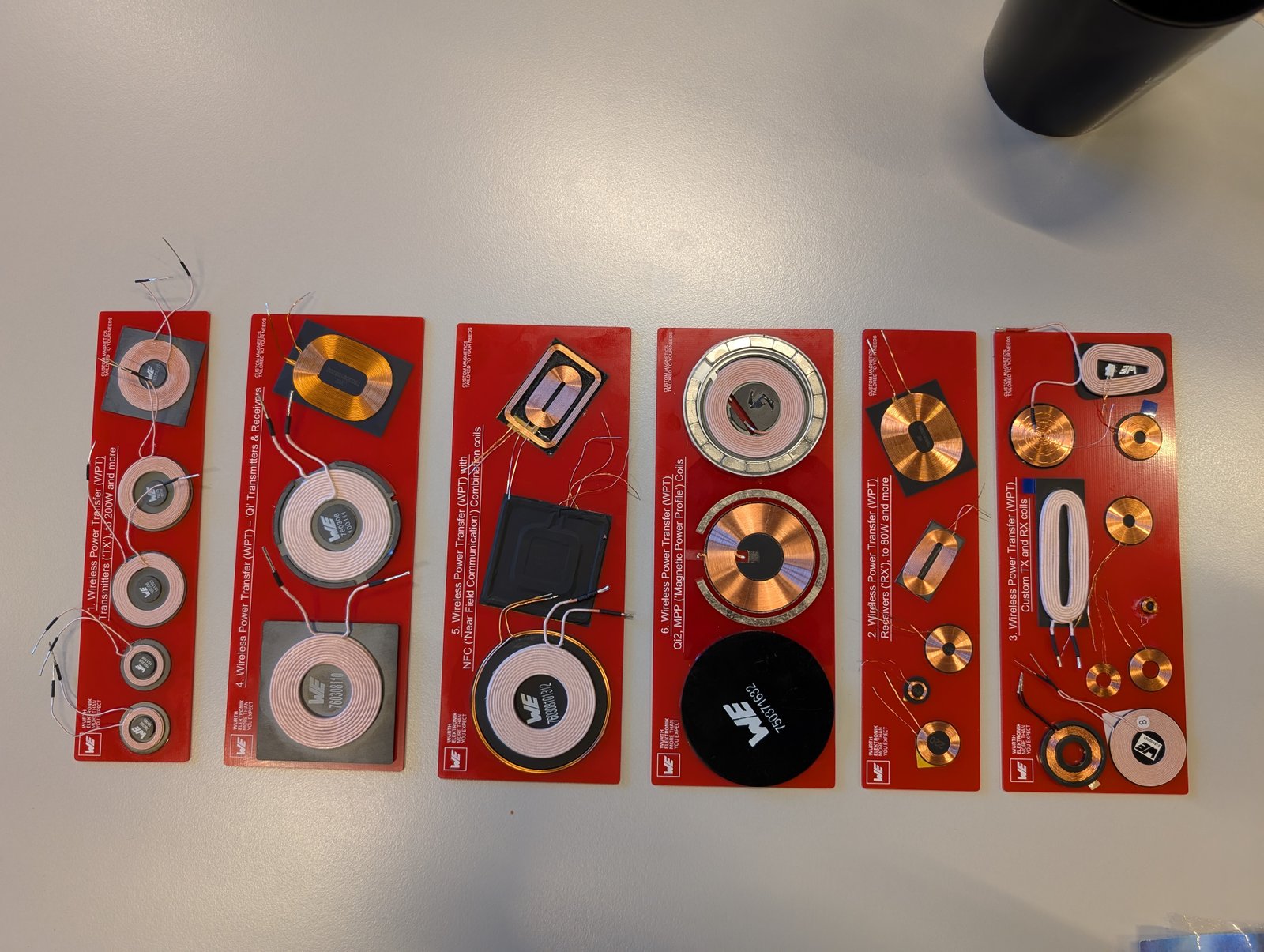
The Wireless Power Consortium (WPC) develops wireless power transfer standards for a wide range of applications, from consumer electronics to kilowatt-level systems. Its most widely adopted standard is Qi, which targets smartphones, wearables, robots, and drones with power levels up to 30 W.
Key Characteristics
- Power range: up to 30 W
- Charging profiles: 5 W (Baseline Power Profile) and 15 W (Extended Power Profile)
- Power transfer method: Inductive and magnetic resonant wireless power transfer
- Operating frequency: 87-205 kHz (Qi v1), optionally 360 kHz (Qi2)
- Maximum transfer distance: up to 4 cm
- Communication method: In-band communication over the power link
- Target applications: Smartphones, wearables, robots, drones, and consumer electronics
Qi2 Improvements
- Magnetic alignment using permanent magnets in transmitter and receiver
- Improved charging efficiency and reliability
- Enhanced foreign object detection
- Support for multi-transmitter and multi-receiver operation
- Operation at 360 kHz to reduce interference with vehicle key fobs
- Introduction of the Magnetic Power Profile (MPP)
Future Developments
The WPC is expanding its portfolio with additional standards. The Ki Cordless standard targets kitchen appliances such as blenders, coffee machines, cookers, and toasters, supporting power levels up to 2.2 kW through inductive power transfer combined with NFC-based smart control. A second initiative focuses on wireless charging for light electric vehicles, including e-bikes, e-scooters, and monowheels, with targeted power levels up to 500 W.
AirFuel Alliance
The AirFuel Alliance was formed through the collaboration of the Power Matters Alliance (PMA) and the Alliance for Wireless Power (A4WP). It provides an alternative to Qi by using magnetic resonant wireless power transfer and offering greater spatial freedom between transmitter and receiver.
Key Characteristics
- Power range: 1.5 W to 50 W
- Power transfer method: Magnetic resonant inductive power transfer
- Operating frequency: ISM bands, typically 6.78 MHz
- Communication method: Bluetooth Low Energy (BLE)
- Target applications: Smartphones, headsets, wearables, laptops, and consumer electronics
- Standardization: Harmonized internationally as IEC 63028
Advantages
- Greater positional freedom compared to tightly aligned inductive systems
- Support for charging multiple devices simultaneously
- Operation in globally recognized ISM frequency bands
- Suitable for embedded and consumer applications
SAE J2954 (Automotive)
SAE J2954 defines wireless power transfer requirements for light-duty plug-in and battery electric vehicles. The standard specifies interoperability, electromagnetic compatibility, safety requirements, alignment methodologies, testing procedures, and minimum performance criteria for automotive wireless charging systems.
Key Characteristics
- Charging classes: WPT1 (3.3 kVA), WPT2 (7.7 kVA), WPT3 (11.1 kVA)
- Power transfer method: Inductive power transfer (IPT)
- Operating frequency: 79-90 kHz
- Communication method: Wi-Fi at 2.4 GHz
- Target applications: Light-duty plug-in hybrid and battery electric vehicles
- Scope: Interoperability, EMC, EMF, safety, alignment, and testing
Recent Developments
An updated version of SAE J2954 introduced positioning functionality to support autonomous alignment between the ground assembly and the vehicle assembly, simplifying the charging process for users.
Future Developments
- Wireless charging for heavy-duty vehicles (SAE J2954/2)
- Dynamic wireless charging while driving (SAE J2954/3)
- Bidirectional charging and Vehicle-to-Grid (V2G) functionality
Related Automotive Standards
| Standard | Coverage | Geographical Scope |
|---|---|---|
| IEC 61980 | Ground Assembly | International |
| ISO 19363 | Vehicle Assembly | International |
| ISO 15118 | Communication | International |
| UL 2750 | Full System | United States |
| GB/T 38775 | Full System | China |
Comparison of Standards
The table below compares key parameters of the most relevant application-level WPT standards.
Table: Comparison of application-level wireless power transfer standards.
| Standard (organization) | Qi2 (WPC) | WLC (NFC Forum) | AirFuel Resonant | SAE J2954 |
|---|---|---|---|---|
| Applications | Wearables, smartphones | Small wearables, IoT devices | Headsets, phones, laptops | Plug-in hybrid and battery electric vehicles |
| Power | 5 W - 15 W (up to 30 W) | 0 W - 1 W | 1.5 W - 50 W | 3.3 - 11.1 kVA |
| Transfer distance | Up to 4 cm | Up to 2 cm | Several cm | Typically 10 - 25 cm |
| Power transfer method | Inductive power transfer | Inductive power transfer | Inductive power transfer | Inductive power transfer |
| Power frequency | 87 - 205 kHz, 360 kHz | 13.56 MHz | ISM bands (typically 6.78 MHz) | 79 - 90 kHz |
| Data transmission | In-band FSK | RF link | Bluetooth Low Energy (BLE) | Wi-Fi (2.4 GHz) |
| Multiple devices | Yes | Yes | Yes (up to 8 devices) | No |
| Standardized charging classes | BPP, EPP, MPP | WLC | Resonant | WPT1, WPT2, WPT3 |
Sources
Document based on:
- A. Cloet, H. Farbakhsh, M. Kleemann, and B. Minnaert, “Recent Advancements in Technologies, Applications, and Regulations of Near-Field Wireless Power Transfer,” in IEEE Access, vol. 14, pp. 49285–49310, 2026, doi: 10.1109/ACCESS.2026.3674000.