Industrial IPT Demonstrator for Wireless Supercapacitor Charging
This demonstrator was developed to investigate wireless charging of supercapacitors on moving grippers in industrial weaving machines. The system replaces wear-prone carbon brush contacts using inductive power transfer (IPT) and validates reliable charging during high-speed motion.
At a glance
Proof-of-concept inductive power transfer system designed for wireless charging of supercapacitors in a high-speed industrial textile application.
- Technology: Inductive Power Transfer (IPT)
- Application: Wireless charging of weaving machine grippers
- Operating frequency: 85 kHz resonance
- Practical operating frequency: 69 kHz
- Compensation topology: LCC-S
- Energy storage: 6-cell supercapacitor bank
- Target transferred energy: ≈80 mJ per cycle
- Maximum measured efficiency: 62.6 %
- Effective charging zone: 3 cm
- Industrial partner: Picanol Group
Why was this setup developed?
Industrial weaving machines currently use carbon brushes to charge moving grippers. These contacts wear over time, require maintenance, and may generate sparks in dust-sensitive environments.
The demonstrator was developed together with Picanol Group to investigate whether wireless power transfer can replace sliding carbon brush contacts.
The application is particularly challenging because charging is only possible during very short time intervals while the gripper moves at high speed.
Unlike many wireless charging applications, the receiver is only coupled to the transmitter for a few milliseconds during each cycle and experiences a continuously changing coupling factor.
The project therefore focuses on:
- Short-duration wireless charging
- Variable coupling conditions
- Supercapacitor energy storage
- No-load operation
- Compatibility with existing machine electronics
System architecture
The demonstrator follows a classical IPT architecture consisting of a high-frequency inverter, compensation network, wireless inductive link and supercapacitor-based receiver.
The system consists of the following functional blocks:
- DC power supply
- Full-bridge inverter
- LCC-S compensation network
- Transmitter coil
- Receiver coil
- Full-bridge rectifier
- Supercapacitor charging circuit
- Supercapacitor energy storage bank
Energy is transferred through magnetic coupling between the transmitter and receiver coils. The received AC voltage is rectified and used to recharge the supercapacitors mounted on the moving gripper.
LCC-S compensated IPT topology
The demonstrator uses an LCC-S compensation network to maintain robust operation under changing coupling conditions.
The coupling factor varies continuously as the gripper moves along the charging zone. Conventional compensation networks often suffer from strong performance variations under these conditions.
The selected LCC-S topology behaves as a quasi-constant current source on the transmitter side. This keeps the primary current nearly constant even when the receiver is absent.
Key advantages include:
- High tolerance to coupling variation
- Safe no-load operation
- ZVS-capable operation
- Reduced current stress
- Stable wireless charging behaviour
Hardware implementation
The proof-of-concept combines a full-bridge transmitter, resonant compensation network and compact receiver designed for integration on a weaving machine gripper.
- Full-bridge MOSFET inverter
- IR2110 gate drivers
- LCC-S compensation network
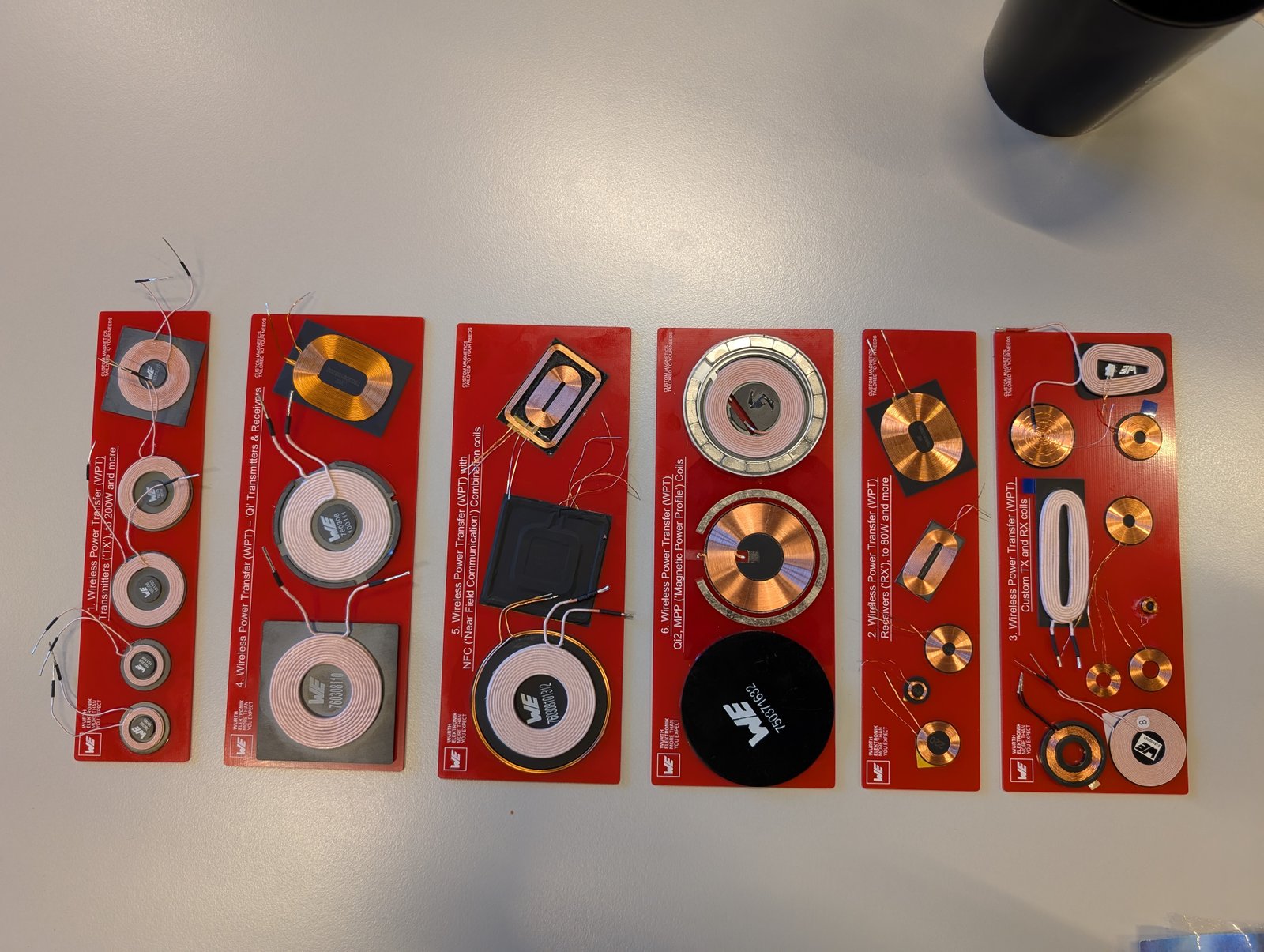
- Würth Elektronik IPT coils
- Schottky diode bridge rectifier
- 6-cell supercapacitor bank
- TL431-based overvoltage protection
- Microcontroller-controlled validation platform
The receiver was intentionally kept compact in order to match the mechanical constraints of the industrial gripper assembly.
Performance
Experimental measurements confirm that the demonstrator successfully charges the supercapacitor bank under realistic operating conditions.
- Resonant frequency: 85 kHz
- Operating frequency: 69 kHz
- Maximum coupling factor: 0.75
- Effective charging zone: 3 cm
- Maximum measured efficiency: 62.6 %
- Primary current variation: 19 %
- Operating supercapacitor voltage: 10 V – 15 V
- Required transferred energy: ≈80 mJ per cycle
- Measured energy surplus at 600 rpm: 20.5 mJ per cycle
Measurements demonstrate that the supercapacitor bank is charged faster than it is discharged, resulting in a positive energy balance for all investigated machine speeds.
Industrial relevance
This demonstrator illustrates how wireless power transfer can replace mechanical charging contacts in industrial motion systems.
The technology is particularly relevant for applications where moving components require continuous charging but where wired connections or sliding contacts introduce wear and maintenance.
Potential applications include:
- Industrial weaving machines
- Automated production equipment
- Linear transport systems
- Moving robotic tooling
- Industrial shuttle systems
- Wireless charging of mobile industrial assets
The demonstrator also serves as a valuable research platform for studying IPT under highly dynamic coupling conditions.
Resources
Summary paper - English (pdf)
Master thesis manuscript - Dutch (pdf)
Sources
Document based on:
- S. Vandenbosch, "Wireless Power Transfer for Charging Supercapacitors in a Linearly Accelerating System", Master's Thesis, KU Leuven, 2025-2026.
- Project developed in collaboration with Picanol Group.